
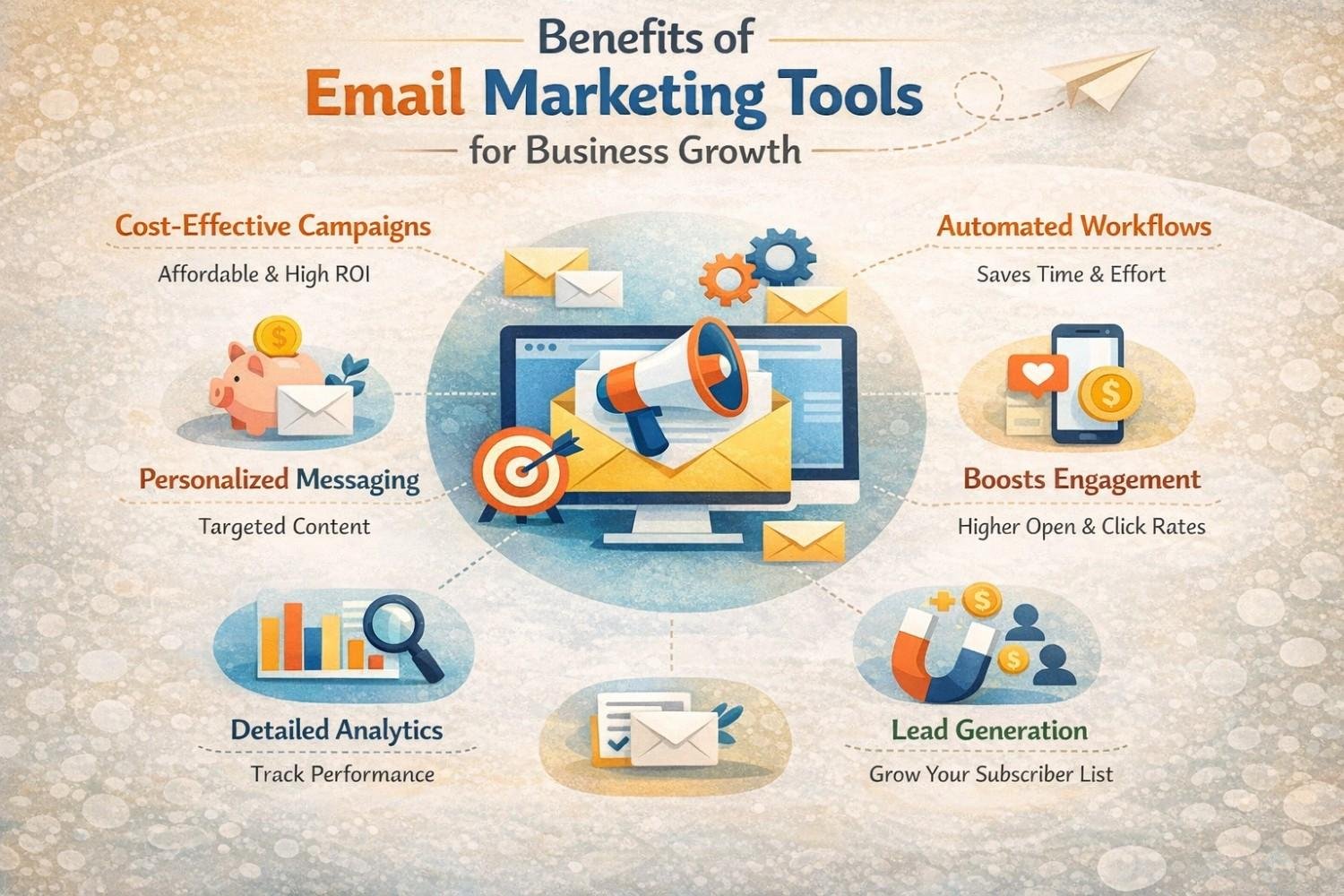
Email marketing tools have become one of the most reliable growth engines in modern digital marketing. Despite the rise of new channels, email marketing software continues to deliver exceptional ROI, direct audience ownership, and long-term customer engagement—especially in Tier-1 markets such as the United States, United Kingdom, Canada, Australia, and Europe.
Today’s email marketing platforms are far more than bulk email senders. They combine automation, AI-driven personalization, advanced analytics, and CRM integrations to help businesses scale revenue, improve customer lifetime value (LTV), and reduce customer acquisition cost (CAC).
What Are Email Marketing Tools?
Email marketing tools are cloud-based software solutions that enable businesses to create, automate, send, and analyze targeted email campaigns. These platforms allow brands to communicate directly with leads, prospects, and customers using personalized and behavior-based messaging.
Most modern email marketing automation software integrates seamlessly with:
- CRM systems
- E-commerce platforms
- Customer data platforms (CDPs)
- Analytics and tracking tools
This makes email marketing a core component of high-performing digital marketing stacks.
Why Email Marketing Tools Are Essential for Business Growth
- Direct customer access without algorithm dependency
- High ROI marketing channel compared to paid ads
- Scalable automation for growing businesses
- Data-driven optimization and performance tracking
In high-CPC markets, owning your audience through email is a major competitive advantage.
Key Benefits of Email Marketing Tools
1. Higher Return on Investment (ROI)
Email marketing ROI consistently outperforms many digital channels. With automation and personalization, businesses can generate more conversions at a lower cost—particularly in SaaS, finance, insurance, and enterprise sectors.
Optimized email marketing campaigns drive:
- Higher open rates
- Better click-through rates (CTR)
- Stronger conversion performance
- Improved revenue attribution
2. Automation That Scales Revenue
Email marketing automation allows businesses to send behavior-triggered messages without manual effort. Automated workflows nurture leads and customers around the clock.
Common automation flows:
- Welcome and onboarding sequences
- Abandoned cart recovery
- Post-purchase follow-ups
- Renewal reminders
- Re-engagement campaigns
This creates a 24/7 revenue engine for growing companies.
3. AI-Powered Personalization
Modern AI email marketing tools use behavioral data to deliver highly relevant content. Personalization elements include:
- Dynamic subject lines
- Product recommendations
- Location-based offers
- Predictive send times
- Lifecycle-based messaging
Advanced personalization significantly improves engagement and customer experience.
4. Stronger Customer Retention
Email customer retention strategies help businesses maintain ongoing relationships through newsletters, loyalty programs, product updates, and targeted offers.
Consistent communication builds trust and increases long-term customer value.
5. More Effective Lead Nurturing
For B2B and SaaS companies, email lead nurturing is critical. Automated drip campaigns educate prospects, address objections, and guide users through the sales funnel.
This is especially valuable for businesses with longer buying cycles.
6. Real-Time Analytics and Insights
Advanced email marketing analytics provide deep visibility into campaign performance.
Key metrics tracked:
- Open rates
- Click-through rates
- Conversion rates
- Revenue attribution
- Engagement trends
These insights enable continuous optimization and smarter marketing decisions.
Email Marketing Tools vs Traditional Marketing Channels
| Marketing Channel | Cost Efficiency | Scalability | Personalization | ROI Tracking |
|---|---|---|---|---|
| Email Marketing Tools | High | Excellent | Advanced | Accurate |
| Paid Advertising | Medium | Budget-limited | Moderate | Good |
| Social Media Marketing | Low-Medium | Algorithm dependent | Limited | Partial |
| Traditional Advertising | Low | Low | None | Difficult |
How Email Marketing Tools Drive Revenue Growth
Well-implemented email marketing automation directly impacts revenue through:
- Abandoned cart recovery campaigns
- Cross-sell and upsell sequences
- Product launch promotions
- Subscription renewal flows
- Transactional email monetization
Email Marketing Tools by Business Type
E-commerce Businesses
Online stores use email automation for ecommerce to recover lost sales, increase repeat purchases, and boost average order value (AOV).
SaaS Companies
SaaS email marketing focuses on onboarding, feature adoption, upgrade prompts, and churn reduction.
B2B and Enterprise Organizations
B2B email marketing platforms support lead nurturing, account-based marketing (ABM), and complex sales cycles.
Security, Compliance, and Trust
Leading email marketing platforms include built-in compliance with global regulations:
- GDPR (EU \& UK)
- CAN-SPAM (USA)
- CASL (Canada)
Features such as consent tracking, encryption, and automated unsubscribe management help maintain sender reputation and legal compliance.
AI and the Future of Email Marketing Tools
Artificial intelligence is rapidly transforming email marketing software. Key innovations include:
- Predictive analytics
- Automated content generation
- Intelligent segmentation
- Send-time optimization
- Behavior-based targeting
AI enables higher engagement with less manual effort, making email one of the smartest long-term marketing investments.
How to Choose the Right Email Marketing Tool
- Depth of automation workflows
- CRM and SaaS integrations
- Email deliverability reputation
- Scalability and pricing model
- Strength of analytics and reporting
Final Thoughts
Email marketing tools remain one of the most powerful drivers of sustainable business growth. By combining automation, AI personalization, deep analytics, and seamless integrations, modern platforms help companies acquire customers efficiently, retain them longer, and maximize lifetime value.
For businesses operating in competitive Tier-1 markets, investing in advanced email marketing software is not just a marketing upgrade—it is a strategic growth decision that delivers measurable and long-term results.